Rethinking rivers: Their greatest services may be the ones we overlook
What is a river worth? Not only its water, or the agriculture it supports. Not only the hydropower, or the ecosystems along its path. The river, in its entirety.
UC Santa Barbara professor Rafael Schmitt has given this question a lot of consideration, because the value we place on a river influences every decision we make about its use, development and restoration. Schmitt studies the interdependencies between human society and rivers: how our actions impact them, how the services they provide support us, and the feedback between the two. His research highlights opportunities to use rivers in a way that produces the greatest benefits with the lowest impacts.
In a recently published article in Spektrum der Wissenschaft (the German-language edition of Scientific American), Schmitt and his co-authors make the case that the full value of Southeast Asia’s Mekong River — including fisheries, sediment delivery, cultural meaning and biodiversity — remains underestimated and overlooked in decision-making, particularly regarding the major hydropower dams that threaten the rivers’ future. A concurrent, peer-reviewed study, also authored by Schmitt, in Nature Sustainability then works to address this gap by quantifying ecosystem services and integrating their monetary value into economic considerations. The paper reveals that the economic costs of lost sediment alone would justify an investment in solar, wind and energy storage instead of a slew of major dams proposed for the Mekong.
“Most people would agree that rivers are important, but we often lack a clear understanding of the full range of values they provide to society,” said Schmitt, an assistant professor in the Environmental Studies Program. “This gap leads to decisions that prioritize short-term economic gains over the long-term natural capital rivers sustain.”

Rafael J. P. Schmitt studies the interconnections between river systems and societies, with a special focus on sustainable water infrastructure and the Water-Energy-Food-Ecosystem Nexus. His Lab for River System Science and Sustainability (RS³) develops new models to understand river and...
The value of sediment flow
It’s relatively straightforward to place monetary value on certain services a river can provide: electricity generation, recreational use, water allocation, etc. “But you can’t easily put a dollar value on many of the functions of a river,” Schmitt said. As a result, these services aren’t accounted for in discussions on matters of economics and policy. However, the benefits of some of these externalities can dwarf many of the services we can quantify.
The Mekong River is the longest in Southeast Asia, flowing through six countries before forming the Mekong Delta, where it empties into the South China Sea. Roughly the size of the Netherlands, the Mekong Delta is home to 15 million people, and a major agricultural center.
It’s also about two meters above sea level. The delta will inevitably shrink in the coming decades as the ocean rises; however, the sediment flux from the Mekong would build up the retreating delta, providing a measure of climate resilience to the region.
Unfortunately, dams interfere with this process, jeopardizing the lives and livelihood of those living near the coast. “If all dam sites on the Mekong were to be built, only 5% of the original sediment load would still reach the delta,” Schmitt said. In this scenario, some of his models predict more than 90% of the delta would be below sea level by the end of the century.
Because sediment transport is hard to assign value, this crucial process currently isn’t considered in economic decisions. So Schmitt set out to compare a simple economic analysis with one that includes the cost of lost sediment flow.
Schmitt’s co-author on the Spektrum der Wissenschaft article, Apisom Intralawan, previously used the agriculture and fishery output to estimate the monetary value of sediment from the Mekong River. This produced a low-end figure of $20 per ton, which does not include riverbank stabilization and the food security it affords, particularly to vulnerable groups, emphasized Intralawan, a professor at Mae Fah Luang University in Thailand. Yet, even this conservative estimate yields a value of $3.6 billion per year for sediment alone.
When Schmitt and his colleagues from the National University of Singapore included this cost in an energy systems model, it shifted the market’s preference toward distributed energy sources, like solar and wind. The authors found that substituting 19 proposed dams with solar, wind and energy storage could preserve up to 98% of sediment delivery to the delta at only a modest cost increase (around 5%). “Even if you only include the value of sediment, then you already find that building these big dams is not only impactful, it’s also suboptimal from an economic perspective,” he said.
This research reveals a fundamental tradeoff between climate change mitigation and adaptation. While hydropower helps with mitigation by reducing greenhouse gas emissions, trapping sediment undermines our ability to adapt by destabilizing deltas and coastlines, explained lead author Xiaogang He, an engineering professor at the National University of Singapore. “The key insight is that hydropower infrastructure can be strategically substituted with other renewables, like solar and wind,” he said, “but once river sediment is lost, it's gone forever. You can't manufacture sediment to replace what's trapped behind dams.”
There’s currently only one major dam on the main stem of the lower Mekong River, but Laos broke ground in 2024 on a second main-stem dam, with several others planned. That said, the team identified pathways for countries to meet their climate goals without sacrificing the natural sediment flows that communities depend on for flood protection and agricultural productivity. “This requires thinking beyond individual projects to optimize the entire energy system,” said He. The benefits of this perspective extend far beyond the Mekong to any river basin facing similar development pressures.

Choosing a timeframe
In August 2025, Schmitt and Zeb Hogan, at University of Nevada, Reno, recruited experts from a variety of fields for a workshop on the economics of rivers. Their goal: Come up with an estimated value of the Mekong. Rather than a practical exercise, the intention was to build a scientific foundation to account for the true worth of rivers. Schmitt also hoped to attract the attention of decision makers in Southeast Asia who are currently considering major infrastructure projects along the Mekong, as well as on others, like the Zarlung Tsangpo, one of the major tributaries of the Ganges.
Economic theory began converging toward indigenous knowledge as the event progressed. Among the concepts that arose was the Seventh Generation Principle of the Haudenosaunee, also known as the Iroquois Confederacy. It states that, when making decisions today, we need to consider their impacts seven generations in the future.
In modern economics, this ethos translates to the concept of a discount rate, which is the relative weight placed on a good or service now compared to some time in the future. Many economic assessments use fairly high discount rates (7-8%) over a rather short period, like 50 years, Schmitt explained. In other words, they place a much higher value on using a resource now rather than saving it for later. Our choice of discount rate can have a huge effect on valuation; poor choices can lead to drastically undervaluing the future worth of a resource.
Correcting this will require discount rates with longer time horizons. “We probably need to rethink how we actually assign these discount rates and which kind of economic framework we use to look at them,” Schmitt said.
“Many of these services might become even more valuable in the future,” he added.
Considering ecosystem services
Sediment transport vs hydropower is one of the key conflicts along the Mekong, which is why Schmitt focused on it in his study. However, there are an untold number of services the natural world provides to society. Sound decisions will require properly weighing the benefits of development against those of an ecosystem as it is. Because when we aggressively harness a river’s natural resources, a lot of the services the river used to provide for free are lost, and society must pay to replace them.
For instance, dams in the western United States have provided irrigation, power and flood control, but they’ve cut off the spawning grounds of the region's salmon and steelhead. To replace this service, the U.S. government spent nearly $88 million on fish hatcheries and related activities in 2017, according to a report from that year. Despite this, many are collapsed, and Native American tribes that thrived on them for centuries now face food insecurity and poor health.
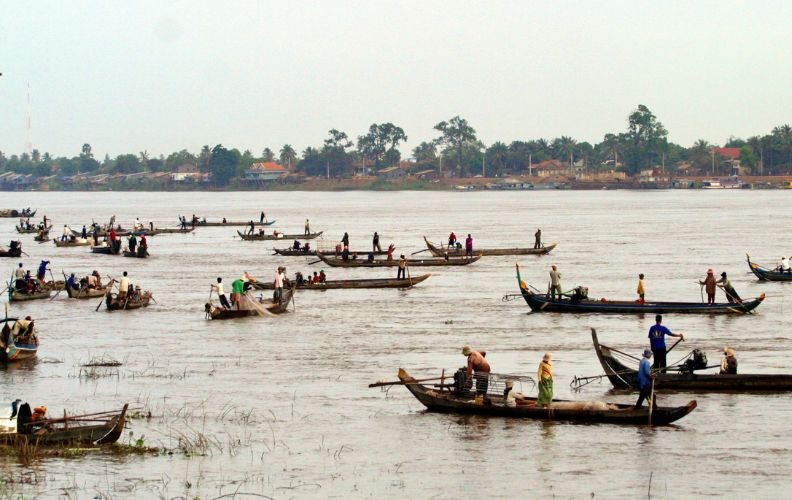
The Mekong has the highest fishery production of all rivers in the world, Schmitt said, and its delta supports 5% of the world’s rice production. Hydroelectric dams will increase energy availability, but changing the river dynamics will impact the region’s food supply by disrupting the fisheries and delta. “You take these values for granted until they are gone,” he said.
This highlights the equity aspect of river development. Often these infrastructure projects benefit urban populations, while the costs are borne by rural communities along the river corridor. A dam’s impacts on agriculture, fishing and climate resilience will certainly hit those in Southeast Asia’s countryside harder than residents of the region’s major cities.
By Schmitt’s estimate, the Mekong River is among the most valuable rivers in the world—not only because of its fisheries, farming and hydropower potential, but also for its overlooked ecosystem services like sediment transport, cultural values and biodiversity. His research study and science article highlight how most current economic assessments miss these broader contributions, and how telling the story of the river’s worth is just as important as calculating it.
Share this article



Related Stories