
Three UC Santa Barbara faculty members have received honors this year from the American Geophysical Union, the country’s preeminent earth science professional organization.
AGU selected earth science Professor David Valentine for the 2026 Ambassador Award, which acknowledges a researcher’s outstanding contributions to one or more of the following areas: societal impact, service to the earth and space community, scientific leadership and promotion of talent. The organization also chose him to deliver the William S. and Carelyn Y. Reeburgh Lecture, which recognizes contributions to global biogeochemistry and marine geochemistry.
Meanwhile, Assistant Professor Leander Anderegg received the James B. Macelwane Medal, which distinguishes early-career scientists for significant contributions to earth and space science. AGU also announced that Professor Kelly Caylor has been elected as an AGU Fellow for the 2026 class.
“It's rare to see three colleagues recognized by AGU in the same year, and at three different points in their careers,” said Rachel Segalman, vice chancellor for research. “This speaks volumes to the importance of UCSB’s contributions to earth and environmental science. I’m delighted for David, Leander and Kelly, and proud that they do their work here.”
Bringing science into the public discourse
Valentine has already accumulated quite a list of honors, but explained that the Ambassador Award holds a deeper meaning for him. “It's a really wonderful honor because it's not just recognizing the work that my team does in the lab and in the field to make new discoveries, but it's really looking at what we do to contextualize our work in a broader scientific context and communicate all that science to the public,” Valentine said.
Valentine studies the ecology and biochemistry of hydrocarbons, such as the oil seeps in the Santa Barbara Channel. His expertise has led him to consult on high profile disasters like the 2010 Deepwater Horizon spill and the 2015 Refugio oil spill; his discovery of toxic waste off the coast of Southern California led to an exposé by the Los Angeles Times and subsequent award-winning documentary.
This sort of outreach and professional ethic enables science to have an impact beyond the laboratory. “It resonates with people, and it can guide change where change is needed,” Valentine said. But it requires the hard work of disseminating and explaining the implications of discoveries. And it calls for a sustained commitment to communicate new insights wherever it matters most, be that to politicians, regulators or the general public. “I think that's probably what being an ambassador means in this context.”
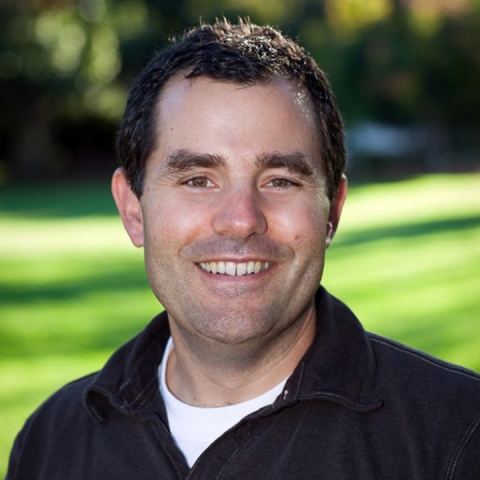
Research interests include the interactions of microbes and the Earth system. Specific areas include the Archaea, biogeochemistry and microbial ecology of hydrocarbons, and the development of novel isotopic approaches to study microbes and geochemical processes.
Many years ago, Valentine declined a media interview he felt unprepared for. When the segment aired that night, he was disheartened to see how poorly their expert guest conveyed the science to the public. “I made a pact with myself,” he said, “to always respond to requests for interviews, to media, to whatever the situation is if I think that I can actually inform an issue.”
Valentine also sees his involvement in public discourse as a boon to his students and lab members. “I think everybody benefits from communication, and we embed that here in our graduate programs,” he said. “It’s up to each student if they want to go that route, but I try to offer the opportunity.”
Valentine aims to provide his students with support and flexibility without dictating the choices they make. Each one gets to take ownership of their own project, and he works to help them realize individual success, regardless of where that may lead. It’s a mentorship style largely based on the approach of his advisor, William Reeburgh. “Bill was an amazing advisor,” Valentine said, “so it makes me feel a little bit fuzzy inside to be honored with the lectureship that's named for him.”
The intricacies of plants and their environments
Since joining UCSB in 2021, Anderegg has emerged as a hotshot researcher in plant sciences, as evinced by his many awards and recognitions. “The Macelwane Medal is the biggest early career honor in earth and environmental science,” explained Caylor, UCSB’s associate vice chancellor for research, innovation and entrepreneurship.
The distinction isn’t lost on Anderegg. “I'm really honored to receive this award,” said Anderegg. “The potential applicant pool is large — researchers up to 10 years out of their Ph.D. from all of earth and space science — which is pretty humbling.
“It also feels like a validation that the questions I've been chasing are interesting and important,” he continued, “and I'm not just off in a corner studying something that no one else cares about.”
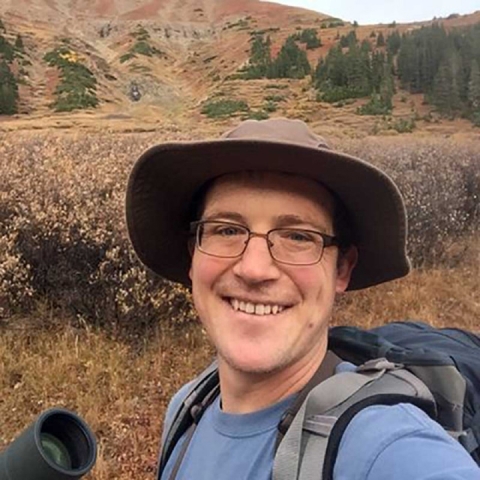
Leander Anderegg's research seeks to scale up the physiological responses of plants to biotic and abiotic stress to explain population level, community level and biogeographic processes. His work asks: How do plants cope with stress? What biophysical and evolutionary constraints...
Anderegg uses physiology as a tool to study how plants respond to climate change, and the effect these responses have on an ecosystem as a whole. He’s particularly interested in learning how much these traits can vary within a species. This variation can tell scientists how a species has adapted to the places it lives, as well as how much an individual plant can adjust in response to environmental changes. Humans display some of this variation as well, such as when our skin tans after we’ve been in the sun, or when our fingers callous from routine work.
By studying variation, Anderegg hopes to learn how much plants can alter their physiology to cope with the new climate of the 21st century and what happens when they pass their limits. These insights can help land managers promote resilient ecosystems. For instance, some of his research aims to identify where plants are most vulnerable to drought so that we can target those places for active management, like restoration or prescribed burns.
Anderegg has begun branching out from plant physiology, as well, lending his expertise and tool set to other fields and disciplines. “It's really fun to figure out how plants work,” he said, “but even more exciting to team up with evolutionary biologists, remote sensing experts and modelers to apply that knowledge to understand tree microbiomes, measure global photosynthesis from space or redesign how we model global plant diversity.”
Supporting science in far flung lands
Caylor was thrilled to hear that he had been elected as an AGU fellow. “All of my mentors have been very active in AGU, and so it always felt like a core part of my professional identity,” he said. “Being elected fellow is just a huge moment of reflection to think about all the different versions of myself and my science that have attended AGU over the years.”
Throughout his career, Caylor’s research has revolved around drylands — regions like deserts, grasslands and chaparral. He’s worked extensively in East and Southern Africa studying how savanna and woodland ecosystems respond to climate variability. “These systems are understudied because they're often very remote, and most people who do intensive, long-term field work in environmental science tend to work locally to make logistics easier,” said Caylor, a professor in the Department of Geography and at the Bren School of Environmental Science & Management.
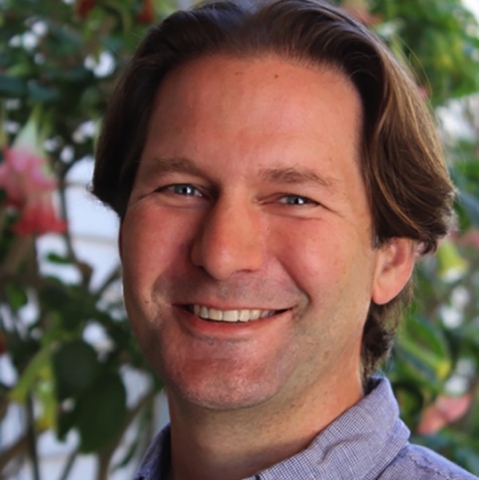
Kelly Caylor seeks to develop improved insight into the way that land use and climate change are interacting to affect the dynamics and resilience of global drylands. His primary research sites are in sub-Saharan Africa, where he is focused on...
Like Anderegg, Caylor began his career studying plants, which form the foundation of terrestrial ecosystems. Over time, this has broadened to collaborations that include human geography, economics and social science. Because despite their remoteness, these are landscapes where people live and earn their livelihoods. “We're doing basic discovery in places where the applications are the most important: ecosystems that are in need of scientific understanding, and where that understanding can more readily translate into impact on the ground for the people whose livelihoods depend on these landscapes.”
And Caylor is increasingly aware of how his students and mentees are amplifying the impact he has on his field, and the world at large. “I'm proud of the way they've embraced our lab group's ethos of working hard on problems that matter across a wide range of careers and professions," he said. This larger picture is precisely why he’s been active in AGU all these years.
Share this article



Related Stories


